Venera 7 came to the world spinning—the turning of lathes and screws, the whirring of electrical sensors, the screams of grinding metal, the smell of engine oil, the voices of the workers—men and women—who oversaw delivery. Slowly, mind and body came together, and Venera became whole, with the red initials “CCCP” emblazoned on breast. The mechanical cosmonaut was inspected, photographed, filmed, and shown off to senior members of the revolutionary vanguard. All were in agreement: Venera 7 was ready to show that the Soviet space program was still able to lead the world barely a year after Neil Armstrong planted a capitalist flag on The Moon.
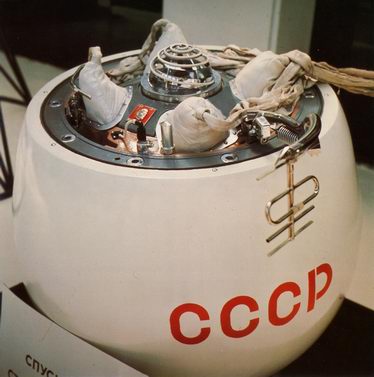
Fig. 1. Venera 7
After the last photos were taken and the final box was ticked, the adventurer was sealed into the nosecone of what was essentially a modified intercontinental ballistic missile. A few days before farewell, the gargantuan doors of the assembly and testing building cracked open, the pristine controlled environment shattered by a hazy August breeze from the wide grasslands of southern Kazakhstan. Venera’s last terrestrial journey was a slow railway trip to the launchpad, accompanied by a swarm of uniformed officials on foot who watched carefully for any deviation. The launchpad resembled a giant flower with petals of steel frames. The rocket was levered into the center of the flower, before the petals closed in.
Soviet space launches could be considered far less bombastic than their American counterparts. For one thing, there was no countdown booming on loudspeakers for thronging spectators. Instead, at a local time of 10:38am on August 17 1970 the quiet summer’s morning was roared awake as kerosene met supercooled liquid oxygen in the rocket’s four main boosters. After a short delay, the petals of the flower opened, the hand of the proletariat releasing our adventurer into the cloudless sky.
___
The journey between planets was long and quiet, four months of silence punctuated by two course corrections. Our adventurer spent the crossing strapped to a larger spacecraft that was resplendent with outstretched solar panels, a giant radio dish for speaking with home, and a mechanical eye that navigated by the stars. The eye watched as their destination slowly grew more distinct, a thin crescent against the intense sun.
On the final approach, Venera 7 was awoken, solar panels powering up our adventurer’s batteries. The craft passed into the planet’s shadow, the mechanical cosmonaut staring down into the unknown void, a place that had swallowed up the previous Veneras and killed them before they touched the ground. On December 15, 1970, at an altitude of 135 kilometers and a speed of 11.5 kilometers per second, Venera 7 disengaged with the carrier spacecraft and hurtled into the Venusian night.
Earth’s emissary tore through the planet’s upper atmosphere, emitting a myriad of blues and violets as atoms were sheared apart. In 32 seconds our adventurer covered 75 kilometers towards the planetary surface, but brakes were being rapidly applied by the impact of alien air on Venera 7’s titanium shell, and at an altitude of 60 kilometers a parachute was deployed, as well as a radio antenna that started beaming messages towards home.
Things started going wrong. Six minutes after deployment the parachute was ripped up by violent winds, leaving Venera 7 to fall towards the planetary surface. Our adventurer hit the ground at 60 kilometers per hour, bounced, and landed at the wrong angle. The mechanical cosmonaut lay dying, desperately attempting to send signals back to Earth, but instead transmitting directly into the Venusian soil.
___
It takes several minutes for radio signals to make the crossing from Venus to Earth, so at the time of impact Soviet scientists were waiting with baited breath. Upon seeing the signal turn to meaningless noise, many of the scientists would have rolled their eyes and given up on Venera 7 as yet another victim of the hazards of interplanetary travel. Perhaps some senior officials would have felt a shiver down their spine, as they imagined having to explain another failure to the party hierarchy.
However, not everyone gave up so easily. Upon returning from the New Year break, a radar astronomer decided to rerun the tapes of the descent signals. After a period of intense listening, he would have frantically called his boss, who would have called his boss, who would have called his, right up to the chairman of the Presidium of the Supreme Soviet. It was weak and barely detectable, but it was there, the first signal from the surface of another planet.
Scientists the world over poured over the data. Venera 7 had taken off in temperatures of around 27°C, but landed in temperatures closer to 475°C. Launch was on a clear summer’s day with a gentle breeze, but landing was under pressures comparable to a kilometer under the ocean, in a place where rains of sulfuric acid evaporate before reaching the ground. For over a century, there had been hopes that underneath the clouds Venus was a hospitable world–Venera 4 had even been built to land on water–but Venera 7 had confirmed that the planet named after the goddess of love was a harsh mistress indeed.
___
Right now, in the opening decades of the twenty-first century, we are in the midst of a giant leap in understanding our universe and its weather. Before the invention of the telescope around 1600, humans only really had any knowledge of the surfaces of two worlds other than our own—the Moon and Sun. Between 1600 and 1995, partly thanks to explorers like Venera 7, we became familiar with the weather on seven other planets, constantly caught off guard by the strangeness and wonder of each new discovery. And then, in the short span between 1995 and 2025, astronomers detected more than 6,000 planets orbiting other stars, and we are just beginning to uncover the weather of these strange new worlds and what it means for us back on Earth. This blogpost traces this four-hundred year journey, expanding the scope of weather’s story beyond our pale blue dot.
___
We do not know who invented the telescope, but it was most likely for the purpose of making money. First emerging in the Netherlands, they coincided with the earliest stock exchanges, when advance knowledge of ships arriving laden with silk and spices suddenly became very valuable. We also do not know who first turned their telescope to the heavens—it is nice to imagine some bored urchin, employed by a merchant to spy shipping from the shore, turning their telescope upwards and becoming the first human to see the Moon’s craters, Saturn’s rings, and Jupiter’s moons. Such a person most likely could not read or write, and may not have seen much significance in what they could make out. Either way, they left no record for us to find. Eventually, towards the end of the first decade of the 1600s, telescopes found their way into the hands of educated men who wanted to impress their wealthy benefactors. It is these names—Galileo Galilei first and foremost—that come down to us as the pioneers of telescope astronomy. However, despite his fame, Galileo’s telescopes were not powerful enough to clearly make out weather systems on the surfaces of other planets—he simply drew them as blank disks.
It would take another thirty years before anyone would build such a telescope. Nowadays, many like to make a clear distinction between scientists and tradespeople. Scientists are supposed to be aloof—those who dedicate their lives to staring God straight in the eyes and uncovering the mysteries of the universe. They are often seen as above the hubbub of society and the need to sell their services to the rich and powerful. This stereotype has never really been true, but it was especially untrue for those who investigated nature in the seventeenth century. Courtiers saw such scholars as having bad manners and worse dress sense, and stage performances lampooned scientific luminaries. In such an environment, astronomers could not afford to be aloof—they had be extremely adept to navigate these social hurdles in order to gain support for their work. They had to know how to charm the right people. They had to hustle.
This fact of life was not lost on the Neapolitan optician and lens maker Francesco Fontana as he put the finishing touches to a recently rediscovered letter addressed to the Grand Duke of Tuscany in Autumn 1639. Two years earlier, the Grand Duke had bought one of Fontana’s lenses for a tidy sum. Fontana would have welcomed the money, but this was nowhere near as valuable as the patronage of one of the most powerful men in Europe—a person of status would not dare disrespect one of the Grand Duke’s favorites. However, since this coup, Fontana’s lenses had been returned to him under the pretense that they were of inferior quality. An aging Galileo, who held influence at the Grand Duke’s court, grumbled that no new telescope could ever reveal more than what Galileo himself had already uncovered, and there were those who jealously protested that no lenses could be superior to those produced in Florence.
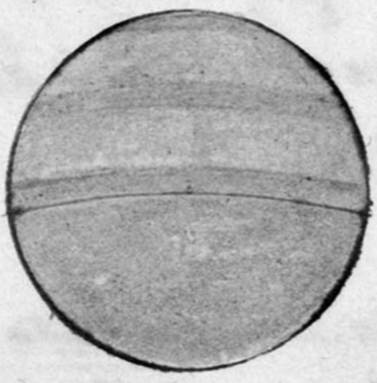
Fig. 2. The first known depiction of another planet’s weather (1639), used in an attempt to sell a telescope and charm a Grand Duke. We do not know if this attempt was successful.
In order to regain the Grand Duke’s favor, Fontana would have to pull out a showstopper, a demonstration of such brilliance that no one, not even Galileo, could deny the superiority of his lenses. In his letter, he claimed to have it:
Having finally regained the strength to be at your service, I have created a lens which is without comparison far better than any other made previously, because new things in the planets can be seen through it.
Fontana finished his letter with the required declaration of humbleness and servitude, and then added a small sketch of a planet on a separate note (Fig. 2). The picture is curious and somewhat underwhelming, looking more like a lollypop than a cosmic behemoth, but its modesty belies with the gargantuan scale of what it portrays. This seventeenth-century lens grinder had caught slight of the largest and arguably most beautiful planetary weather system in the solar system—bands of light and dark stretching hundreds of thousands of kilometers across Jupiter’s surface. These are manifestations of Jupiter’s strong winds that alternate between easterlies and westerlies, creating swirls and eddies where they drag across each other. The night that Fontana had first spotted these bands he thought there was a problem with his lenses, but now he felt confident enough to use them in his sales pitch, in doing so creating the first confirmed image of weather on another planet.
As ever more powerful telescopes were made, more details could be made out in Jupiter’s clouds. In the 1690s, the Italian-French astronomer Giovanni Domenico Cassini was able to work out that Jupiter’s bands rotated at different rates and that therefore the planet was not solid—one of the first confirmations that other planets had something like an atmosphere. Jumping forward to 1831, astronomers observed a storm larger than Earth that still rages almost two-hundred years later—the Great Red Spot—over 16,000 kilometers wide with winds exceeding 400 kilometers per hour. Finally, in the twentieth century scientists discovered that Jupiter’s atmosphere primarily consisted of hydrogen like the Sun, meaning the Jupiter could almost—but not quite—float on water. But many mysteries still remain, including exactly why the bands of Jupiter contrast so sharply in color as Fontana identified four centuries ago. Jupiter has always delivered when it comes to dramatic weather—the majesty of the planet’s atmosphere remains a wonder to behold even with amateur telescopes—but its most exciting revelations may be yet to come.
___
Such is the size and magnificence of Jupiter, astronomers uncovered its atmosphere well before those of our nearest planetary neighbours. As with many scientific discoveries, Venus’s atmosphere was found by accident, by an eighteenth-century astronomer who was looking for something else. June 6, 1761 was marked in astronomers’ calendars from Newfoundland to the Cape of Good Hope, for it was the day that Venus would cross, or transit, between the Sun and Earth. One of these was the Russian Mikhail Lomonosov, a peasant’s son who had walked a thousand kilometers to Moscow and lied about his humble origins in order to gain an education. In the leadup to the transit, Lomonosov had an argument with another scholar about the precise path that Venus would take, meaning that on the morning of June 6 Lomonosov’s eye was firmly glued to his telescope’s eyepiece. Upon Venus’s approach to the Sun’s disk, Lomonosov saw, just for a second, a ring of light surround the planet (Fig. 3). He later realized that this was a telltale glint of Venus’s atmosphere, leading him to wonder whether there were people living on the planet, and if so whether they had been baptized into the faith of Christ.
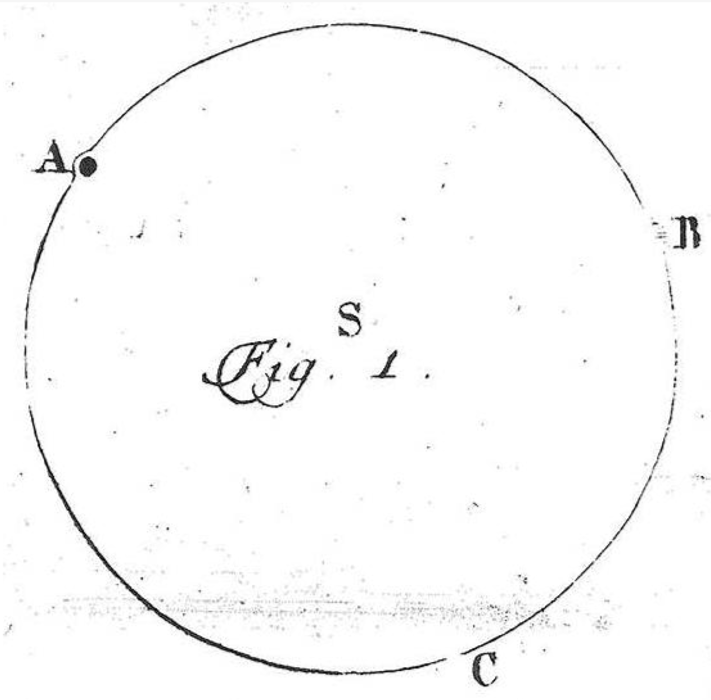
Fig 3. Lomonosov’s depiction of Venus (A) at the edge of the Sun’s disk (1761). The apparent bulge in the Solar disk is believed to be sunlight bouncing off Venus’s atmosphere
Mars’s atmosphere was conjectured by the German-British astronomer and composer William Herschel in 1784, when he observed occasional changes on the planet’s surface, noticing that large areas darkened and brightened:
[…] these alterations we can hardly ascribe to any other cause than the variable disposition of clouds and vapours […] that planet has a considerable but moderate atmosphere, so that its inhabitants probably enjoy a situation in many respects similar to ours.
Herschel accompanied his written observations with sketches (Fig. 4) that were published in the Royal Society’s journal. With a flourish of his pencil, Herschel became the first person to capture the legendary Martian dust storms. Sometimes, when such storms encircle the whole planet as they did in 2018, the brightness of the planet noticeably changes even to the naked eye.
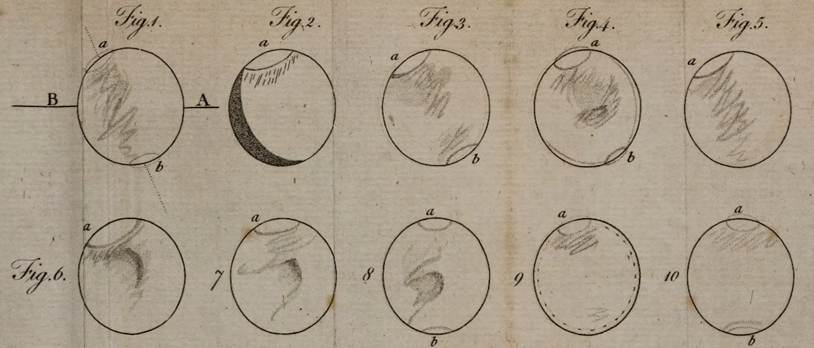
Fig. 4 Herschel’s sketches of Mars (1784)
The discoveries of atmospheres on Venus and Mars fired the imagination like never before. Jupiter is a very alien world to terrestrials, the rotating bands suggesting a chaotic interior. In contrast, Venus is a similar size to Earth, and Mars has many Earth-like features like ice-caps and nearly 24-hour days. As shown by the musings of Lomonosov and Herschel, such similarities supercharged long-existing ideas of cosmic pluralism—the belief in many worlds that could hold many forms of life.
With Venus’s thick clouds obscuring the planet’s surface, conjecture was used to fill in the blanks. Although was assumed that Venus’s clouds were made out of water, the planet was nevertheless thought to be quite inhospitable to Earthlings, not because it was unable to support life, but because it could support too much. Europeans, inspired by stories of colonial expeditions, drew comparisons with the swamps, rainforests, and jungles of Earth. US medical doctor Gustav W. Pope’s 1895 novel Journey to Venus (Fig. 5) spoke of “… its remarkable meteorological phenomena; its earthquakes, volcanoes, and tempests; its immense mountains, forests, and jungles, with their primeval vegetation; its wonderful and monstrous forms of life; its great mammals, land and sea monsters…” The stories Parasite Planet and The Lotus Eaters, written in 1935 by the tragically short-lived Stanley G. Weinbaum, portray a Venus filled with ruinous spores, roving carnivorous protoplasms, and a multitude of parasitic horrors, yet still offering opportunities to adventurers and traders willing to exploit the planet’s biological riches.
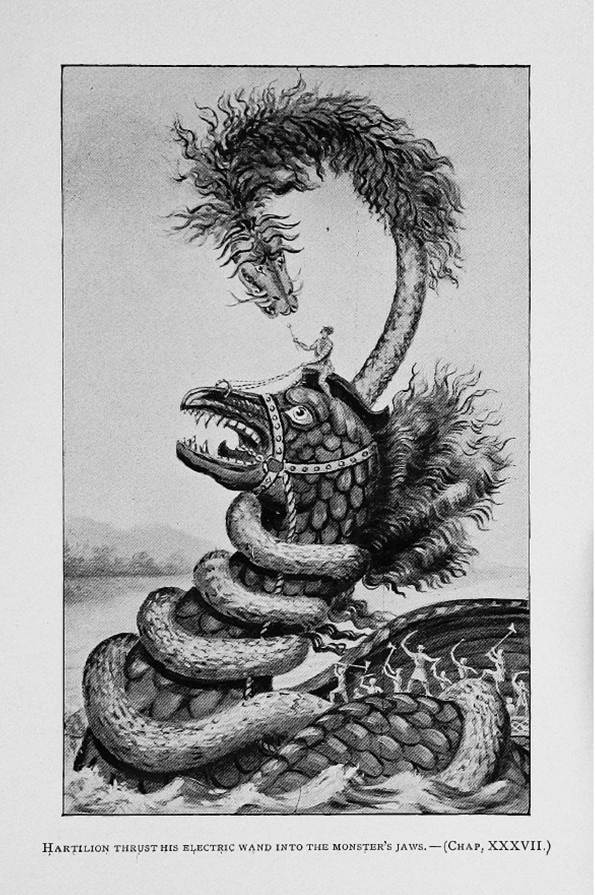
Fig 5. Typical day on Venus, as portrayed by Gustav W. Pope (1895)
Mars, on the other hand, had a surface that was tantalizingly visible, leading astronomers to strain their eyeballs searching for any details. The viewing conditions were far from perfect—any small movement of Earthly air was capable of making ruining the view even through the best telescopes. Under these difficult conditions, astronomers reported dark channels crisscrossing the Martian surface. In 1895, the US astronomer Percival Lowell claimed that these channels could only be irrigation canals carrying water from the snowy poles to the arid equator, claiming that hydration would be the dominant concern of Martian society: “… in these Martian minds there would be one question paramount to all the local labor, women’s suffrage, and Eastern questions put together,—the water question.” It is perhaps no coincidence that Lowell was writing from Arizona, where canal-based irrigation was turning deserts green. H. G. Wells, writing in War of the Worlds (1898), spoke of a Martian atmosphere whose temperature barely approached the coldest winter day on Earth, causing great hardship to its denizens: “The immediate pressure of necessity has brightened their intellects, enlarged their powers, and hardened their hearts.”
Such beliefs in Venus and Mars’s life-sustaining atmospheres persisted well into the twentieth century, even when observations increasingly questioned the underlying assumptions. Measurements in the 1920s and 30s suggested that Venus’s clouds were in fact composed of a thick blanket of suffocating carbon dioxide, capable of warming the planet’s surface to hellish temperatures. Later, more direct Earth-based measurements of the Venusian cloud tops indicated a temperature of over 300°C, making the idea of Venusian jungles increasingly unlikely. Measurements of the Martian atmosphere were equally disconcerting—Lowell’s canals dissolved when observed with ever-larger telescopes, most likely a trick of the eye. However, with Venus especially, some scientists were willing to become contortionists in order to argue for an Earth-like surface, for example suggesting that the Venusian atmosphere was hot on top and cooler underneath, hiding a clement zone. As the century wore on, it became increasingly clear that arguments around the habitability of the Martian and Venusian atmospheres were not going to be settled from the surface of the Earth.
___
The science fiction of the late-nineteenth century echoed throughout the world, the words leaping off the page or the wireless into adolescent imaginations. Shortly after reading War of the Worlds, a seventeen-year-old Robert H. Goddard climbed a cherry tree on his family property:
It was one of the quiet, colorful afternoons of sheer beauty which we have in October in New England, and as I looked toward the fields at the east, I imagined how wonderful it would be to make some device which had even the possibility of ascending to Mars…
Similar revelations were happening the world over, especially in the German and Russian empires. This new generation of dreamers, Goddard among them, did not just want to observe and imagine other worlds—they wanted to build new machines to go. The journey from youthful enthusiasts playing with toy rockets in fields to suited men commanding billion-dollar space programmes was messy and bloodstained. Almost all received funding from military interests, and some in Nazi Germany made use of slave labour, with more people dying in the construction of the formidable V2 rockets than in their employment as a weapon during the Second World War. On June 20, 1944, a V2 prototype became the first human-made object in Outer Space, a milestone that will unfortunately always be held by the Nazis. After the War, space exploration became the subject of great power competition between the United States and Soviet Union, both of whom made use of captured (and apparently forgiven) German technicians, leading to new missions to Mars, Venus and beyond.
The first interplanetary efforts were a comedy of errors. The Soviet Union’s first Mars mission in 1960 shook its navigation system apart during launch and burnt up over Siberia. The Americans’ first attempt at a Venus mission, Mariner 1, fared little better, veering off course due to what was essentially a typo in the software. Then, in 1962, Mariner 2 became the first successful interplanetary voyager, passing within 35,000km of Venus—a hair’s breadth on interplanetary scales. More successes, as well as many failures, followed, with the Americans and the Soviets competing in what became known as the “Space Race”. In the 60s, the United States was the first to perform flybys of Mars and Venus, whereas the Soviet Union was the first to send probes that impacted the surface of both planets (only one of these high velocity impacts was intended as such). The Soviets were also the first to perform “soft landings” on both planets in the 1970s, but the Americans were the first to operate a wheeled Mars rover in 1997. Despite many claims to the contrary, who actually “won” the Space Race is still open to debate.
These missions put to bed the idea that the Martian and Venusian atmospheres were in any way welcoming to Earth’s citizens. Mars was too cold, Venus was too hot, and both atmospheres were dominated by poisonous carbon dioxide. In addition, Mars’s atmosphere was razor thin and Venus’s was oppressively thick. Dreams of Venusian jungles and Martian canals were largely put to rest. However, discussions of the atmospheres of other planets did not cease, but shifted. Scientists wondered what had caused both planets to become so inhospitable—why had Mars lost most of its atmosphere, and why had the opposite happened with Venus? With Mars, part of the problem was that the Red Planet was just not heavy enough to cling to its atmosphere, which largely escaped into the void. With Venus, ideas center around a “runaway greenhouse effect”. As primordial Venus warmed, its oceans began to evaporate. Water vapour, the stuff that makes up Earth’s clouds, is excellent for trapping heat—think about how cold a cloudless night can get. Due to Venus being closer to the Sun, enough water evaporated in order to set off a vicious cycle; more water vapour warmed the planet, and a warmer planet caused more water to evaporate, until eventually the oceans disappeared and the surface reached the temperature of an industrial furnace.
Venus has become known as “Earth’s evil twin”, and for half a century has served as an apocalyptic foreboding for those warning of the effects of climate change on Earth. There are major concerns that the runaway greenhouse effect of a marginally warmer-than-Earth Venus could be replicated on an anthropogenically-warmed Earth, with the oceans evaporating into the sky, leaving our planet desiccated. Carl Sagan, a Venus expert and renowned science communicator, brought this to attention in 1980’s Cosmos, at that time the bestselling science book ever:
The surface environment of Venus is a warning: something disastrous can happen to a planet rather like our own.
Sagan repeated such warnings at a US congressional hearing in 1985 in front of a captivated Al Gore, who was to become a leading climate advocate in the 1990s and 2000s. Much like in early science fiction portrayals, Venus is a planet that inspires fear, but now that fear emanates from the Venusian atmosphere itself rather than what it may contain.
If Earth has an ideal or normal atmosphere, Venus and Mars represent terrifying extremes. However, the space age has also revealed an atmosphere in the solar system that holds many similarities with Earth, with rains, rivers and lakes, all at an atmospheric pressure very similar to our own. Titan, a moon of Saturn, was first observed in 1655 by the Dutch astronomer Christiaan Huygens. For over 300 years afterwards, the moon appeared almost featureless—a poor accompanist to Saturn’s magnificent rings. The Pioneer and Voyager spacecraft of the 1970s and 80s took photographs of Titan as they zoomed past, but they were not quite capable of seeing through the atmospheric haze. Then, in 2004, the US Cassini probe went into orbit around Jupiter and took detailed images of Titan, catching the telltale glint of a surface ocean (Fig. 6) and tracing the characteristic shapes of river valleys. Cassini then released the European Huygens lander to touch down on Titan’s surface—the most distant landing ever undertaken by a human spacecraft—taking photographs of rounded pebbles that were most likely shaped by regular flooding events. More discoveries are yet to come. The US Dragonfly mission, scheduled to launch in 2028, will send a small drone to whizz around the Titanic atmosphere. Other proposals include a “splashdown” lander designed to float in Titan’s seas, a hot-air balloon that would sail across Titan’s clouds, and even a submarine that could sample the sea floor.
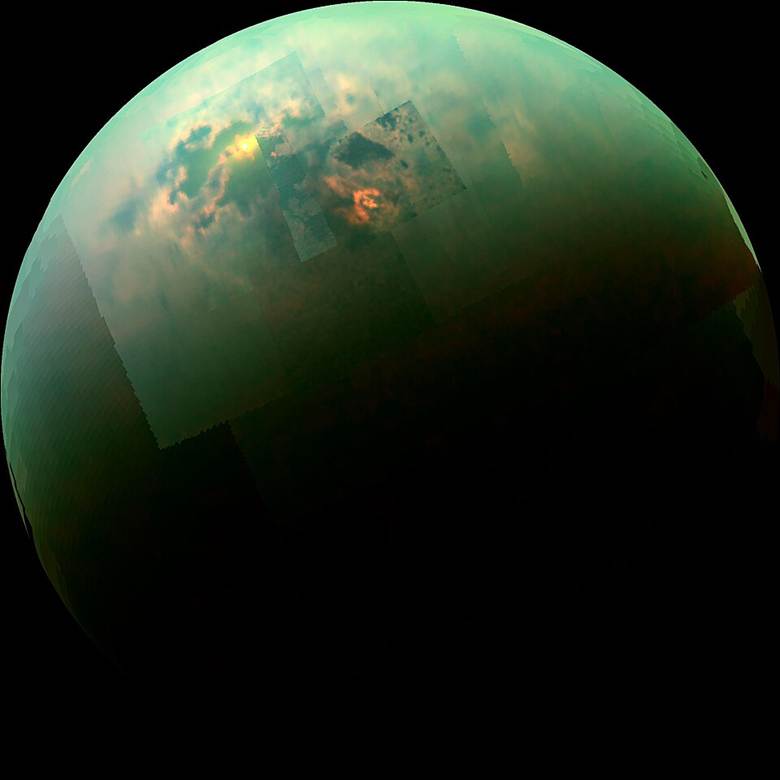
Fig. 6 The seas of Titan glinting in the Sun, pictured on August 21, 2014 by the Cassini spacecraft
Despite all this excitement, Titan’s beaches are unlikely to become a hot holiday destination. The average temperature is a chilly -182.55 °C, and the glinting seas are thought to be liquid methane or ethane (basically camping gas), but Titan still demonstrates that some of the most interesting atmospheres can be found by looking outside our immediate cosmic neighbourhood. However, on the scales of the cosmos, Titan is still in our backyard. To truly discover the secrets of planetary atmospheres, we need to look beyond our solar system, to the planets that orbit the stars of our night skies.
___
I was never meant to spend my undergraduate exchange year in Santa Cruz. At my home university of Manchester, I was the President of the University Quidditch Club, a distinction I held despite never reading Harry Potter. Upon receiving my application, some well-meaning employee at the University of California Education Abroad Program decided that I should go to UC Davis, home of the Fighting Farmers of America Quidditch Team. Now, don’t get me wrong, UC Davis is a good university, in fact it is by some measures the best in the United States for Agricultural Sciences, but I found the idea of going there somewhat dissatisfying for two reasons. Firstly, UC Davis is nowhere near the beach—the sea breeze of my California dream giving way to a heavy whiff of cow dung. Secondly, UC Davis did not do the research I was interested in. Davis’s research focused on cosmology—the understanding of the Universe on the largest of scales. I wasn’t so interested in that. I was quite satisfied with the planetary scale, to explore strange new worlds, to seek out new lifeforms and new civilizations. In short, I wanted to discover the extra-solar planets that orbit the night’s stars.
So when one of my Manchester colleagues got scared of the idea of going to UC Santa Cruz—a campus famous for being the origin of the 420 weed festival—the powers that be were kind enough to let us swap. With some trepidation I emailed several professors at UCSC, hoping that one of them would take a lowly undergraduate student on their cosmic adventure. I received a very kind reply from Douglas N. C. Lin, a man who immediately intimidated me by virtue of having his own Wikipedia page. A few days before term started, I hiked from my campsite to nervously knock on the door of this esteemed scholar. Upon sitting down I blurted that I wanted to study exoplanets, and Doug, very patiently, worked out that I had absolutely zero research experience and very little clue as to what research entailed. He set me a little challenge—giving me a program that simulated planetary orbits and telling me to make the output of endless tables of planetary co-ordinates comprehensible. Not knowing how to code, I created the visualizations using Microsoft Excel. Doug was somehow impressed by this and immediately got me simulating more complex stuff on UCSC’s supercomputer—the formation of planets from clouds of cosmic dust.
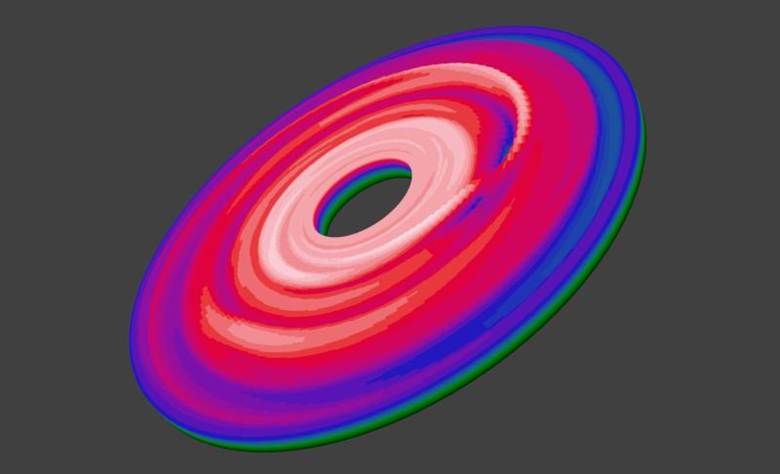
Fig. 8 Result of one of the simulations done by the author. The star lies in the hole of the “donut” and the forming planet is to the right
I was never exceptionally talented at this research, but it was a great learning experience and gave me some good opportunities to meet astrophysicists around the world who came to the department to give seminar talks. One in particular, whose name I have sadly forgotten, came into the department with a spreadsheet that had almost all the confirmed and candidate extrasolar planets listed. I vividly remember him sitting on a sofa with a laptop, showing us a galactic empire’s worth of worlds all neatly tabulated. This was a heady time to be in the exoplanet discovery business. 1,498 exoplanets were officially discovered in 2016—more than four a day!
Exoplanets can be discovered in four main ways. Firstly, in some cases, an exoplanet can be directly imaged using the most powerful telescopes. Direct imaging requires a lot of conditions to be “just right”—an enormous bright hot planet, ideally much larger than Jupiter, a long way away from its host star. Less than two percent of exoplanets have been discovered this way. Secondly, darker planets can be detected when their gravity bends the light of a star directly behind it—this is a rare and short-lived occurrence and the information gained is very limited. Thirdly, the gravity of orbiting planets will always make a star “wobble” slightly, and sometimes this wobble can be detected, representing around a fifth of exoplanet discoveries. Although this is easier than direct imaging, the wobble method still requires incredibly sensitive instruments, and sometimes stars can behave in strange ways that emulate characteristic signals. Instead, almost three quarters of exoplanets discovered so far were found using what is known as the transit method. This is where scientists measure a star’s “wink” as a planet passes in front of it. This is far from a perfect method—for one it requires the planet and the star to line up neatly from our perspective—but it is by far the most accessible. Exoplanet transits are even measurable using high-end amateur telescopes.
Amongst exoplanet researchers, there are plenty of people who simply love the game. They love getting ever more refined measurements out of their instruments, applying ever more sophisticated analysis to their data, creating computer models in an attempt to understand what they are looking at. Some even love rubbing shoulders with the rich and powerful to get funding for new toys. However, others, and I was certainly amongst them, had a perhaps more naïve motivation for pursuing these space rocks; we were in the extra-terrestrial hunting business.
As Percival Lowell’s quest for Martian canals may have shown, looking for aliens is arguably a fool’s game. We have no real idea what we’re looking for. Such beings could be made of dark matter, almost completely undetectable, or they could reside on a plane of existence completely beyond human-made senses altogether. For all we know, Earthlings could be inside a galactic petting zoo, surrounded by metaphorical one-way mirrors, unable to see the beings peering at us—that might explain why we cannot seem to find anyone else in the universe. The mind boggles. To maintain sanity, many exobiologists say that they are looking for life “as we know it”, based on atmospheric oxygen and liquid water. Although this leap of faith narrows down the search parameters, it also throws up enormous challenges, not least the need to detect exoplanet atmospheres.
___
The first exoplanet around another star was only confirmed in 1995, so it may be expected that the possibility to detecting exoplanet atmospheres would be long out of reach. Those expectations would be wrong. The constellation Pegasus, representing the winged horse of Greek mythology, is special in the history of exoplanet discovery. In the right conditions, on a still cold night far away from the city lights, you can spot the star 51 Pegasi with the naked eye, about halfway between two of Pegasus’s brightest stars. On October 6 1995, the planet now known as Dimidium was discovered orbiting that star using the aforementioned wobble method, the first exoplanet confirmed around an alien sun. If, from the perspective of an observer in the northern hemisphere, you look slightly to the right of 51 Pegasi b using a good pair of binoculars, you may spot the unimaginatively named HD 209458, around which the planet we now know as Osiris was found using the transit method in September 1999; the first exoplanet discovered in this way. Following in the footsteps of Mikhail Lomonosov in 1761, astronomers quickly realized that a transiting planet offered new possibilities for understanding the atmospheres of other worlds. If the world’s most sensitive telescope was used, they could potentially measure signals in the starlight as it passed through the edges of the planetary atmosphere. A message was quickly sent to the Space Telescope Science Institute in Baltimore, and on April 25, 2000, only a few months after Osiris was discovered, the Goddard Spaceflight Center in Maryland sent the command for the Hubble Space Telescope to reorientate itself towards the constellation Pegasus.
Over the next three weeks, amongst a busy schedule of other work, Hubble observed four transits of HD 209458 by its companion planet, detecting the faint signs of sodium in its atmosphere, with subsequent studies revealing many other firsts. Osiris is a strange world. A gas giant, it is larger than Jupiter, but is closer to its star than Mercury. It orbits rapidly; a year on Osiris is less than four days on Earth, and its starside has a temperature of over 1,200 °C. The planet is so close to its host star that, driven by the excruciating heat, its hydrogen-dominated atmosphere is rapidly evaporating into space. In 2010, echoing Fontana’s 1639 sighting of Jupiter’s clouds, a European-led team measured Osiris’s windspeed to be up to 7,000 kilometers per hour, representing the first real weather measurement of a world outside of our solar system and leaving the windspeed record of our Solar System in the dust. Osiris is quite unlike any planet in our system, but the fact that it is a large planet so close to its host star makes it particularly easy to detect and study using the transit method. These particular sorts of planets have been termed “hot Jupiters”, and hundreds have been found since.
Osiris’s atmosphere was the first exoplanet atmosphere to be detected, but it was far from the last. The nearest hot Jupiter to Earth currently known, HD 189733 b, has been found to be a deep blue colour, with rains of molten glass. Another hot Jupiter, Kepler-7b, was the first exoplanet to have its clouds mapped, although the resolution currently leaves something to be desired. The first vaguely Earth-like rocky exoplanet, Janssen, was announced in 2004. However, if Venus is Earth’s evil twin, Janssen is the devil incarnate, covered in a lava ocean and a searing atmosphere of what is most likely carbon dioxide and carbon monoxide—not very welcoming. Many other rocky planets are in the right orbit, known as the “Goldilocks zone”, to have an Earth-like atmosphere, but right now the detection of those atmospheres is just out of reach.
As was the case with Venus and Mars in the nineteenth and twentieth centuries, science fiction writers continue to imagine new worlds and their atmospheres. Sometimes these writers are inspired by the latest scientific developments, and sometimes it happens the other way around. In 2011, astronomers discovered a planet that orbits two stars, just like Tatooine in 1979’s Star Wars. Recently, many planets have been discovered that are likely to always present the same side towards their star, meaning their days and nights are eternal, just like in Larry Niven’s 1964 short story The Coldest Place. In 2017, a bored set of researchers attempted to simulate the circumstances required to see the weather conditions on the hit HBO TV series Game of Thrones, finding that the irregular seasonal changes seen in the show could be caused by the planet “tumbling”. The results of this study were published in a constructed fictional languages of Dothraki and High Valyrian alongside English—truly a statement of admirable nerdiness. The idea that we humans can envision new worlds decades before their discovery is testament to the scope of our imaginations.
The exploration of exoplanets is playing out like a fast forward of centuries of Solar System discoveries. Today we have found rains of molten glass and lava oceans, but tomorrow, perhaps in our lifetimes, we may find vast oceans of water and white puffy clouds. New ideas and observation systems are continually being developed, and many scientists are imagining potential future discoveries, including of life. Sara Seagar, a pioneering exoplanet expert, came up with an equation to calculate the number of planets with detectable signs of life. We begin with the number of stars that have been observed (we know this), and we then take the proportion of those stars that behave “nicely” i.e. have no habit of periodically killing everything within several parsecs (we have some idea of this). We then take the proportion of those stars that have a rocky Earth-like planet in the Goldilocks zone that can be observed (we are gaining a better understanding of this), and finally we take the proportion of these planets with life that produces a detectable sign of its existence in their atmospheres (this is the difficult bit). Astronomers across the world are working on each aspect of the Seagar equation, with the hope that one day the answer will be more than one.
___
As Earthlings have imagined and explored the atmospheres of other planets, they have never quite been able to shake thoughts of home. Whether it was Mikhail Lomonosov worrying about whether the Venusians had been baptised in 1761 at a time of religious fervour, or Percival Lowell expressing concern for thirsty Martians from an arid Arizona in 1895, or Carl Sagan warning the world about a runaway greenhouse effect in 1980 when climate change concern was coming to the fore, the way we have thought about the weather on other planets has always been in lockstep with the state of affairs on Earth. It is striking that humans have always assumed that the weather on other planets would in some ways be similar to Earth, and that we are always disappointed, as on Mars and Venus, whenever that turns out not quite to be the case. Perhaps this can give us pause to think about the consequences if the Seagar equation always spits out an answer of one. If we are expending so much effort on the search for an Earth-like atmosphere, perhaps we should also take greater care of the Earth-like atmosphere that we already know of.
Sources
Charbonneau, David, Timothy M. Brown, Robert W. Noyes, and Ronald L. Gilliland. ‘Detection of an Extrasolar Planet Atmosphere*’. The Astrophysical Journal 568, no. 1 (2002): 377.
Cooper, Keith. Amazing Worlds of Science Fiction and Science Fact. Reaktion Books, 2025.
Del Santo, P. (2009). On an Unpublished Letter of Francesco Fontana to the Grand-Duke of Tuscany Ferdinand II de’ Medici. Galilaeana : Journal of Galilean Studies. N. VI, 2009, 1000–1017.
Demory, Brice-Olivier, Julien de Wit, Nikole Lewis, et al. ‘Inference of Inhomogeneous Clouds in an Exoplanet Atmosphere’. The Astrophysical Journal Letters 776, no. 2 (2013): L25.
Goddard, R., Goddard, E., & Pendray, G. E. (1970). (02) The Papers of Robert H. Goddard, Volume I: [1927 and 1933: Material for an Autobiography]. The Papers of Robert H. Goddard, 1–40.
Harvey, B. (2007). Russian Planetary Exploration: History, Development, Legacy and Prospects. Springer Science & Business Media.
Herschel, W. (1784). On the remarkable appearances at the polar regions of the planet Mars, and its spheroidical figure; with a few hints relating to its real diameter and atmosphere. Philosophical Transactions of the Royal Society of London, 74, 233–273.
Hu, Renyu, Aaron Bello-Arufe, Michael Zhang, et al. ‘A Secondary Atmosphere on the Rocky Exoplanet 55 Cancri e’. Nature 630, no. 8017 (2024): 609–12.
Lowell, P. (1895). Mars. Houghton, Mifflin and Company.
Marov, M. Y. (2004). Mikhail Lomonosov and the discovery of the atmosphere of Venus during the 1761 transit. Proceedings of the International Astronomical Union, 2004(IAUC196), 209–219.
Menshutkin, B. N. (1952). Russia’s Lomonosov: Chemist, Courtier, Physicist, Poet. Princeton University Press.
O’Rourke, J. G., Wilson, C. F., Borrelli, M. E., Byrne, P. K., Dumoulin, C., Ghail, R., Gülcher, A. J. P., Jacobson, S. A., Korablev, O., Spohn, T., Way, M. J., Weller, M., & Westall, F. (2023). Venus, the Planet: Introduction to the Evolution of Earth’s Sister Planet. Space Science Reviews, 219(1), 1–61.
Pope, G. W. (1895). Journey to Venus: The Primeval World: Its Wonderful Creations and Gigantic Monsters. Arena Publishing Company.
Powell, Devin. ‘The Drake Equation Revisited: Interview with Planet Hunter Sara Seager’. Space, 4 September 2013. https://www.space.com/22648-drake-equation-alien-life-seager.html.
Sagan, Carl. Cosmos. Random House, 1980.
Sánchez-Lavega, A., García-Melendo, E., Legarreta, J., Miró, A., Soria, M., & Ahrens-Velásquez, K. (2024). The Origin of Jupiter’s Great Red Spot. Geophysical Research Letters, 51(12), e2024GL108993.
Shiltsev, V. (2012). Lomonosov’s Discovery of Venus Atmosphere in 1761: English Translation of Original Publication with Commentaries (arXiv:1206.3489).
Siddiqui, A. A. (2018). Beyond earth: A chronicle of deep space exploration, 1958-2016. National Aeronautics and Space Administration.
Snellen, Ignas A. G., Remco J. de Kok, Ernst J. W. de Mooij, and Simon Albrecht. ‘The Orbital Motion, Absolute Mass and High-Altitude Winds of Exoplanet HD 209458b’. Nature 465, no. 7301 (2010): 1049–51.
‘Strange New Worlds’. Exoplanets. NASA Science, 20 September 2023. https://science.nasa.gov/exoplanets/immersive/strange-new-worlds/.
Tarly, Samwell. ‘The Climate of the World of Game of Thrones’. Philosophical Transactions of the Royal Society of King’s Landing 1, no. 1 (2017): 1–9.
Weinbaum, S. G. (1935). Parasite Planet. Astounding Stories.
Weinbaum, S. G. (1935). The Lotus Eaters. Astounding Stories.
Wells, H. G. (1897). The War of the Worlds. Dover Publications.

