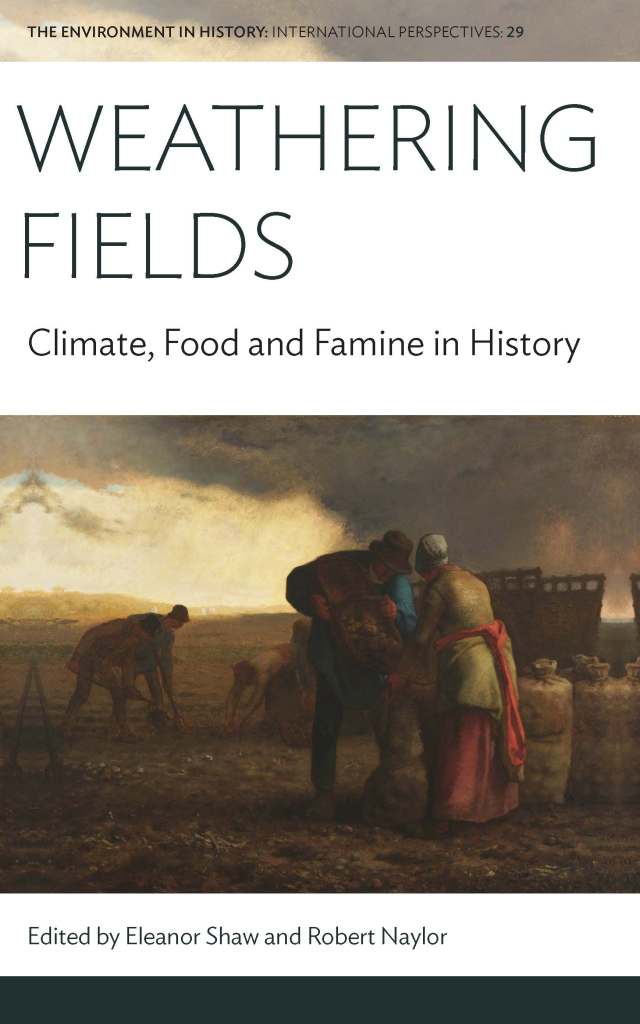
Weathering Fields explores the meanings that people and societies have ascribed to the relationships between climate, famine events and food supplies. Bringing historical perspectives into conversation with contemporary understandings of environment and climate change, it reveals the diversity and local specificity of climate–food interactions while tracing the connections between local experiences and broader global understandings. Case studies range from early modern Korea and seventeenth-Century North-East England, to nineteenth-Century Anatolia and 1920s East Africa. Weathering Fields demonstrates that hunger is fundamentally political, revealing how social relations and power structures have shaped historical experiences of climate, food and famine. In doing so it emphasises the importance of political and social domains for making meaningful change.
Weathering Fields now has a page on the publisher’s website, which includes a kind review by our esteemed colleague Matthias Heymann:
This is a highly welcome volume analyzing the complex and contingent relations between climate, food and famine. […] The volume is a strong historical contribution to counter tendencies of climate determinism and climate reductionism and the use of climate as a tool for depoliticization.
Recommend to your library today!

